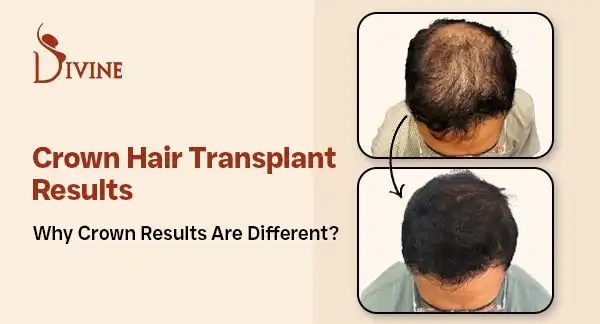
Many patients notice that while the front hairline looks dense and natural, the crown area still appears thinner after a hair transplant. This concern is common—even in patients with strong genetics, excellent donor hair, and successful graft growth.
This does not usually indicate transplant failure. In most cases, the reason is anatomical and optical, not surgical.
Why the Crown Looks Thinner After a Hair Transplant
Even with a technically perfect hair transplant, crown density typically appears 20–25% less than the front. This happens worldwide and is due to three key factors.
1. Crown Anatomy: Curved vs Flat Surface
- Front scalp → relatively flat
- Crown scalp → curved and dome-shaped
A curved surface has a larger surface area to cover.
So even when the same number of grafts per cm² are placed, density appears lower on the crown.
2. Hair Growth Direction in the Crown
- Front hair grows mostly forward and downward
- Crown hair grows in multiple outward directions
Because of this:
- Hair shafts spread apart
- Scalp visibility increases
- Coverage appears lighter
This is why crown hair transplant results often look less dense in photos or bright lighting.
3. Light Reflection & Optical Illusion
The crown reflects light more than flat scalp areas.
This causes:
- Scalp shine under overhead light
- Increased visibility in photographs
- Worse appearance when hair is wet or oily
Even with 100% graft survival, the crown can still look thinner due to light physics.
Common Misunderstanding: “Did My Crown Transplant Fail?”
Many patients assume visible scalp means poor growth.
This is usually incorrect.
Expectations vs Reality
- Comparing crown density to the front is scientifically unfair
- The crown has natural anatomical limitations
- Full scalp invisibility is unrealistic
Important:
A natural, improved crown appearance is the real goal—not front-level density.
This is explained to every crown hair transplant patient during consultation to set realistic expectations for both surgeries.
Book Your Free Consultation Now
Why Classic Whorl (Spiral) Patterns Often Fail
The crown naturally has a spiral pattern, but recreating it surgically has limitations.
When Whorl Patterns May Work
- Small crown areas
- Mild thinning
When They Don’t Work
- Large bald crowns
- Advanced hair loss
In large areas, whorl patterns:
- Increase scalp visibility
- Waste grafts
- Can look unnatural
Straight, uniform graft placement usually provides better cosmetic coverage.
How to Improve Crown Appearance After Hair Transplant
If the crown still looks less dense, these options can help:
1. Hair Fibers
- Instant cosmetic improvement
- Reduces scalp visibility
- Ideal for daily confidence
2. Scalp Micropigmentation (SMP)
- Creates shadow between hairs
- Reduces contrast
- Works well with transplants
3. Second Hair Transplant Session
- Adds additional grafts
- Done only after full growth of first session
- Requires realistic expectations and good donor reserve
Realistic Expectations: The Most Important Factor
A crown hair transplant can:
- Improve coverage significantly
- Reduce visible baldness
- Restore confidence
But:
- Matching front density is rare
- Slight scalp visibility is normal
- Perfection is not medically realistic
Understanding this prevents disappointment and builds satisfaction.
Conclusion
The crown is the most challenging area in hair restoration due to:
- Curved anatomy
- Multidirectional hair growth
- Light reflection
Even the best surgeons face these limitations.
When patients understand the science behind crown density, they feel reassured and confident in their results.
A visible crown does not mean failure —
it means anatomy + physics + biology.
FAQs
Is it normal for the crown to look thinner than the front after a hair transplant?
Yes. This is completely normal due to crown anatomy and light reflection.
Does visible scalp mean grafts didn’t grow?
No. Even with full graft survival, the crown may appear less dense.
Can higher graft numbers completely fix crown density?
Higher grafts help but cannot overcome anatomical limitations fully.
Should I get a second crown hair transplant?
Only if donor hair allows and expectations are realistic.
Why does my crown look worse in photos?
Overhead lighting and camera angles exaggerate scalp visibility.