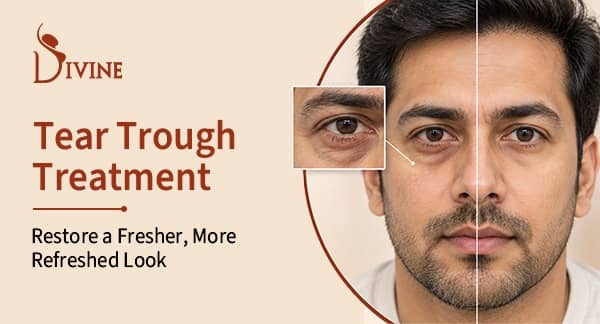
Under-eye hollowness can make the face appear tired, sunken or older, even when you are otherwise well rested. You may notice a groove beneath the eyes, dark-looking shadows, crow’s feet, under-eye bags or a gradual loss of volume around the cheeks.
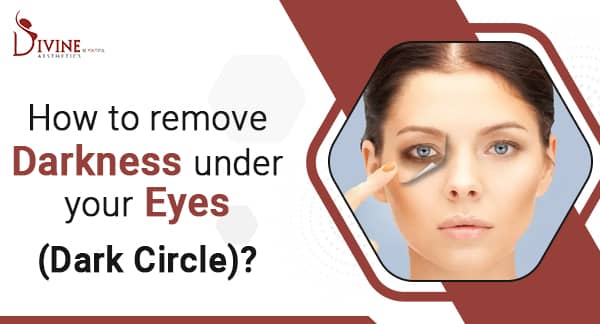
However, dark circles and under-eye hollowness are not always the same problem. Dark circles can be caused by pigmentation, visible blood vessels, thin skin, ageing, genetics or facial anatomy. In some people, the main issue is structural hollowing, which creates a shadow beneath the eyes and makes the area appear darker.
The right treatment therefore depends on why the under-eye area looks hollow or dark in the first place. Depending on your anatomy and concerns, options may include carefully selected dermal fillers, cheek volume restoration, fat grafting, Botox for crow’s feet, or lower blepharoplasty when excess skin or prominent fat bags are present.
This guide explains what tear troughs are, how different treatments work, what recovery may involve, and why an individual assessment is important before choosing a treatment.
What Is Tear Trough Treatment?
Tear trough treatment is designed to improve the hollow or shadowed area between the lower eyelid and upper cheek. Selected patients may benefit from hyaluronic-acid filler or fat grafting to restore volume, while Botox may be used separately to soften dynamic wrinkles such as crow’s feet.
If the main concern is prominent lower-eyelid fat bags or excess skin rather than simple volume loss, lower blepharoplasty may be more appropriate than filler.
The most suitable treatment depends on the cause of the concern, your facial anatomy, skin quality, expectations and previous treatments.
What Is a Tear Trough?
The tear trough is the natural depression that extends from the inner corner of the lower eyelid toward the upper cheek.
The appearance of this groove is influenced by several structures, including the lower-eyelid tissues, orbital fat, cheek volume, skin quality and the underlying facial anatomy. When the transition between the lower eyelid and cheek becomes more pronounced, the area can look concave or hollow.
This may happen because of:
- Genetics and natural facial structure
- Age-related volume changes
- Loss of cheek volume
- Changes in skin quality and elasticity
- Prominent lower-eyelid fat
- The natural shape of the eye socket and cheek
The resulting contour can create a shadow beneath the eyes, which may make dark circles appear more noticeable.
Common Concerns Around the Under-Eye Area
People often use the term “dark circles” to describe several different concerns. These can include:
- Tear trough or deep groove
- Under-eye hollowness
- Dark-looking shadows
- Pigmentation
- Crow’s feet
- Under-eye fat bags
- Fine lines
- Loss of cheek volume
- Loose or thin lower-eyelid skin
Because these concerns have different causes, one treatment does not work for everyone.
Dark Circles vs Under-Eye Hollowness: Are They the Same?
No. Dark circles and tear trough hollowness can occur together, but they are not necessarily caused by the same thing.
Dark-looking under-eyes may result from:
- Pigmentation: Increased melanin or uneven skin tone
- Vascular factors: Visible blood vessels beneath thin skin
- Skin changes: Thinning or ageing of the lower-eyelid skin
- Structural shadows: Hollowing beneath the eyes
- Facial anatomy: The natural relationship between the eyelid, orbit and cheek
When the main problem is structural hollowing, the depression creates a shadow. Even when the skin itself is not significantly pigmented, that shadow can make the area look darker.
This is one reason why creams, peels or pigmentation treatments may not completely improve the appearance when the underlying issue is primarily volume loss or facial contour.
The first step is therefore to identify the actual cause rather than automatically treating every dark circle in the same way.
Botox vs Fillers: What Does Each Treatment Do?
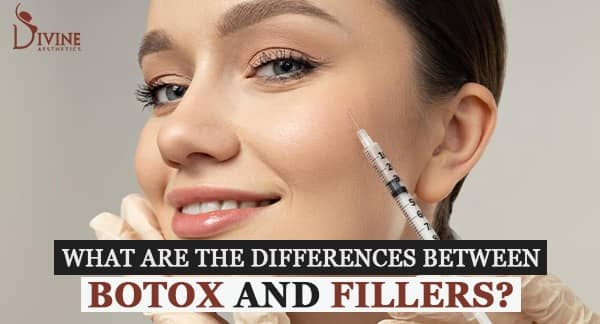
Botox and dermal fillers are often mentioned together, but they work in very different ways.
Botox temporarily reduces muscle activity, making it useful for dynamic wrinkles such as crow’s feet.
Dermal fillers restore volume and modify contours, which can be useful for selected areas of volume deficiency.
For someone who has both crow’s feet and suitable tear trough hollowing, these treatments may sometimes be combined as part of an individualised plan.
| Concern | Possible Treatment | Main Purpose |
|---|---|---|
| Crow’s feet | Botox | Reduces targeted muscle activity and softens dynamic lines |
| Cheek volume loss | Cheek filler | Restores volume and improves facial support |
| Selected tear trough hollows | Tear trough filler | Improves contour and reduces the appearance of shadowing |
| Longer-lasting volume restoration | Fat grafting | Uses the patient’s own fat to restore volume |
| Prominent lower-eyelid fat or excess skin | Lower blepharoplasty | Surgically addresses selected structural concerns |
Botox does not replace lost volume in a tear trough. If the primary concern is a hollow, a volume-restoration treatment or surgery may need to be considered instead.
How We Assess and Correct Tear Trough Hollowness
The under-eye area is delicate, so treatment should begin with an assessment rather than simply injecting the visible hollow.
The surgeon may evaluate:
- Depth and shape of the tear trough
- Cheek volume and projection
- Skin thickness and elasticity
- Presence of under-eye bags
- Degree of pigmentation
- Lower-eyelid laxity
- Previous filler or cosmetic treatments
- Overall facial proportions
For selected patients with mild to moderate volume deficiency, treatment may involve improving the cheek first and then deciding whether direct tear trough correction is necessary.
Step 1: Treat Crow’s Feet with Botox, If Appropriate
If crow’s feet are a significant part of the concern, Botox may be used around the outer corners of the eyes.
The aim is to temporarily reduce excessive muscle activity responsible for these dynamic lines.
Botox does not fill a hollow or replace lost volume. It addresses a different component of facial ageing.
Step 2: Restore Cheek Volume When Needed
Sometimes the under-eye area appears more hollow because the cheek has lost volume or because of the individual’s natural facial structure.
In selected patients, a small amount of cheek filler may be used to restore projection and improve the transition between the cheek and lower eyelid.
The exact product and amount depend on the patient’s anatomy and treatment goals.
Cheek volume restoration may help:
- Improve cheek projection
- Provide support around the lower-eyelid region
- Reduce the appearance of a tear trough
- Soften the transition between the lower eyelid and cheek
- Improve overall facial balance
The aim is not necessarily to place filler into every visible line. In some patients, improving the surrounding facial structure can provide a more balanced correction.
Step 3: Treat the Tear Trough When Direct Correction Is Appropriate
If a visible tear trough remains after assessment of the surrounding structures, a small amount of filler may be considered for selected patients.
The filler is carefully placed to improve the depression and reduce the shadow created by the contour.
However, not every tear trough should be directly filled. Some patients may have prominent lower-eyelid fat, fluid retention, thin skin or other anatomical features that make filler less suitable.
This is why the decision should be based on an in-person assessment rather than simply the depth of the visible groove.
Book Your Free Consultation Now
Tear Trough Filler: What You Should Know
Hyaluronic-acid dermal fillers may be used in selected patients to restore volume and improve under-eye contour.
The treatment is minimally invasive compared with surgery, but the under-eye area requires considerable anatomical knowledge and technical precision.
How Long Does Tear Trough Filler Last?
The duration varies depending on the filler used, the amount injected, individual anatomy, metabolism and how the patient’s tissues respond.
Many patients see results for several months, with some treatments lasting around 12–18 months or longer. Longevity should therefore be viewed as an estimate rather than a guarantee.
Are Tear Trough Fillers Safe?
Tear trough filler can be appropriate for carefully selected patients, but the area around the eyes is anatomically complex.
Possible side effects and complications can include:
- Temporary swelling
- Bruising
- Tenderness
- Asymmetry
- Lumps or contour irregularities
- Persistent puffiness
- Bluish or grey discoloration in some cases
- Infection
- Vascular complications
Rare vascular complications can be serious and, in exceptional circumstances, may affect vision.
For this reason, tear trough filler should not be treated as a routine injection. Proper patient selection, detailed anatomical assessment and appropriate injection technique are particularly important.
Fillers or Fat Grafting: Which Is Better for Under-Eye Hollowness?
There is no single treatment that is best for everyone.
The choice depends on the degree of hollowing, skin quality, cheek structure, available donor fat, expectations and whether the patient wants a temporary or longer-lasting approach.
| Feature | Under-Eye Filler | Fat Grafting |
|---|---|---|
| Material | Dermal filler | Patient’s own fat |
| Procedure | Injectable | Fat harvesting and injection |
| Downtime | Usually shorter | Usually longer |
| Longevity | Temporary | Longer-lasting once stable |
| Reversibility | Depends on product; some HA fillers can be dissolved | Not simply reversible like HA filler |
| Best suited for | Selected patients wanting temporary volume correction | Selected patients wanting longer-lasting volume restoration |
Filler May Be Considered When:
- The hollowing is suitable for non-surgical correction
- The patient wants a temporary treatment
- A small amount of volume restoration is required
- The anatomy does not make direct filler correction unsuitable
Fat Grafting May Be Considered When:
- Longer-lasting volume restoration is desired
- Suitable donor fat is available
- The patient is comfortable with a procedure involving fat harvesting
- More comprehensive facial volume restoration is being considered
Neither option should automatically be considered better. The appropriate choice depends on the individual patient.
Fat Grafting for Under-Eye Hollowness
Fat grafting involves taking a small amount of fat from another area of the body, processing it and carefully transferring it to the required facial area.
Unlike a filler product, the material comes from the patient’s own body.
One important consideration is that not all transferred fat survives. Some of the fat is naturally absorbed during the early healing period, so the final result becomes clearer as the tissues settle.
Once the surviving fat has stabilised, the result can be long-lasting. However, the amount of retained volume varies between individuals, and some patients may require additional treatment.
Why Nano Fat May Be Considered
Nano-fat techniques may be used in selected facial procedures, including around the eyes, as an adjunct to volume or soft-tissue treatment.
Some approaches are intended not only to address contour but also to improve the appearance of the skin.
However, expectations should remain realistic. Nano fat should not be presented as a guaranteed treatment for under-eye pigmentation or dark circles, because pigmentation and other causes of darkening may require different treatment approaches.
Tear Trough Filler vs Lower Blepharoplasty
These treatments address different problems.
Tear trough filler is a non-surgical volume-restoration treatment that may improve suitable hollows beneath the eyes.
Lower blepharoplasty is a surgical procedure that can address selected cases of prominent lower-eyelid fat, excess skin and age-related structural changes.
If the main concern is a hollow caused by volume deficiency, filler or fat may be discussed.
If the main concern is prominent fat bags or excess skin, surgery may be more appropriate.
Some patients may require a combination approach, while others may not be suitable for filler at all.
The correct choice depends on an examination of the lower eyelids, cheek structure and overall facial anatomy.
Who May Be Suitable for Tear Trough Treatment?
Tear trough treatment may be considered for adults who have visible under-eye hollowing and realistic expectations about what treatment can achieve.
Suitability depends on:
- The cause and degree of hollowing
- Skin quality
- Presence or absence of under-eye bags
- Cheek volume
- Lower-eyelid anatomy
- Previous filler treatments
- General health
- Individual expectations
A consultation is particularly important because an under-eye hollow can sometimes be mistaken for pigmentation, swelling or a fat-bag problem.
When Tear Trough Filler May Not Be the Best Option
Filler is not appropriate for every under-eye concern.
A different treatment may be considered when there is:
- Significant lower-eyelid fat bulging
- Excess or significantly loose skin
- Pronounced under-eye puffiness or fluid retention
- Certain anatomical features that increase the risk of filler-related problems
- Previous complications from filler
- Active infection or inflammation
- An expectation that filler will completely remove dark circles caused by pigmentation
In some cases, the better option may be cheek treatment, fat grafting, skincare or pigmentation management. In others, lower blepharoplasty may be discussed.
Recovery After Tear Trough Filler
Recovery after filler is generally shorter than after surgery, although some temporary effects are common.
You may experience:
- Mild swelling
- Bruising
- Tenderness
- Temporary asymmetry
- A feeling of fullness in the treated area
Your doctor will provide specific aftercare instructions. You may also be advised to temporarily avoid activities or pressure that could interfere with the treated area.
The initial appearance may change as swelling settles, so the result should not be judged immediately after treatment.
Recovery After Fat Grafting
Fat grafting involves both fat harvesting and facial treatment, so recovery is generally longer than with an injectable filler.
Swelling and bruising may occur around the eyes and at the donor site. The transferred fat also needs time to settle and stabilise.
Your surgeon will provide individual instructions regarding activity, sleeping position, pressure on the treated area and follow-up appointments.
How Much Does Tear Trough Treatment Cost in Delhi?
There is no single fixed price for tear trough treatment.
The cost can vary according to:
- Treatment required
- Filler brand and type
- Quantity of product used
- Number of areas treated
- Whether cheek and tear trough treatment are combined
- Experience of the treating doctor
- Whether a surgical procedure is required
Indicative Delhi Treatment Ranges
If current local pricing information is published, it should be treated as indicative rather than a fixed quotation and reviewed regularly.
For example, clinics may price treatments differently based on the product and quantity used, while fat grafting and lower blepharoplasty have substantially different cost structures.
The most useful way to compare prices is to ask:
- Which product is being used?
- How much product is included?
- Which areas are being treated?
- Who will perform the procedure?
- Are consultation, procedure and follow-up included?
The final cost should be confirmed after an individual assessment.
What Is the Best Treatment for Under-Eye Hollowness?
There is no universal “best” treatment.
The appropriate option depends on what is causing the under-eye appearance.
- Crow’s feet: Botox may help reduce dynamic wrinkles.
- Suitable mild-to-moderate hollowness: Tear trough or cheek filler may be considered.
- Cheek volume deficiency: Cheek filler may improve support and contour.
- Longer-lasting volume restoration: Fat grafting may be considered.
- Prominent fat bags or excess skin: Lower blepharoplasty may be more appropriate.
- Pigmentation: Skin-directed treatment may be required instead of filler.
The goal is not simply to add volume under the eyes. The aim is to create a balanced transition between the lower eyelid, tear trough and cheek while maintaining a natural appearance.
Frequently Asked Questions
Can Botox correct tear trough hollowness?
No. Botox primarily reduces muscle activity and is commonly used for dynamic wrinkles such as crow’s feet. It does not replace lost volume in a tear trough. Suitable hollowness may instead require filler, fat grafting or, in some cases, surgical treatment.
What is the best treatment for tear troughs?
There is no single best treatment for every patient. Selected patients may benefit from filler, while others may be better suited to fat grafting, cheek volume restoration or lower blepharoplasty. The appropriate treatment depends on the underlying anatomy and cause of the hollowing.
How long does tear trough filler last?
The duration varies by product, anatomy and individual response. Many patients see results for several months, while some may experience results for around 12–18 months or longer. Longevity cannot be guaranteed.
Can tear trough fillers remove dark circles?
Not always. Fillers can improve dark-looking shadows caused by structural hollowing, but they do not directly treat every cause of dark circles. Pigmentation, vascular factors and thin skin may require different treatment.
Is tear trough filler safe?
Tear trough filler can be suitable for selected patients, but the area is anatomically delicate and carries specific risks. Swelling, bruising, asymmetry and contour irregularities can occur, while rare vascular complications can be serious. Proper assessment and injection technique are essential.
Is fat better than filler for under-eye hollowness?
Neither is universally better. Filler may be suitable when a temporary, non-surgical correction is desired, while fat grafting can provide longer-lasting volume restoration once the transferred fat stabilises. The choice depends on anatomy, expectations and available donor fat.
What is the difference between tear trough filler and lower blepharoplasty?
Tear trough filler is a non-surgical treatment used to improve suitable volume deficiency. Lower blepharoplasty is surgery that can address selected cases of excess skin and prominent lower-eyelid fat. A consultation helps determine which approach is appropriate.
How long is recovery after tear trough filler?
Recovery is generally shorter than surgical treatment. Mild swelling, bruising or tenderness can occur and usually settles gradually. Your doctor will provide specific aftercare instructions based on the product, injection technique and individual circumstances.
Can tear trough treatment improve crow’s feet too?
If crow’s feet are caused by dynamic muscle activity, Botox may be used to soften them. Filler and fat address volume and contour rather than the muscle movement responsible for crow’s feet.
Can I get cheek filler instead of tear trough filler?
In selected patients, cheek volume restoration may improve the appearance of the under-eye region without directly filling the tear trough. Whether this approach is appropriate depends on your cheek anatomy, degree of volume loss and overall facial proportions.
When Should You See a Specialist?
If you are concerned about dark circles, hollowness or under-eye bags, it is worth having the area assessed before choosing a treatment.
A specialist can determine whether the main concern is:
- Hollowing
- Pigmentation
- Vascular visibility
- Cheek volume loss
- Fat bags
- Skin laxity
- Crow’s feet
- A combination of several factors
This assessment helps prevent treating the wrong problem with the wrong procedure.
Your Under-Eye Treatment Should Be Planned Around Your Face
Under-eye rejuvenation is not simply about filling a hollow or reducing a wrinkle. The lower eyelid, tear trough, cheek and surrounding tissues all contribute to how the area looks.
At Divine Aesthetics, treatment planning focuses on identifying the underlying concern first and then selecting the most appropriate option, whether that involves Botox, cheek or tear trough filler, fat grafting or a surgical approach such as lower blepharoplasty.
If you are considering treatment for under-eye hollowness or dark-looking shadows, a consultation can help you understand which option is appropriate for your anatomy and goals.
Book a consultation at Divine Aesthetics in Delhi to discuss your under-eye concerns and treatment options.